
A low taper fade buzz cut gives you a clean, sharp head without a daily routine. The top stays short and even. The sides shrink gently toward the ears and neckline. Barbers cut it all day. Even so, many guys leave the chair with a result that doesn’t match the photo they brought.
This guide covers styles, guard lengths, hair types, face shapes, edges, and upkeep. You’ll also get a word-for-word script for your barber, plus a clear comparison with mid tapers and skin fades. Every tip comes from how barbers actually cut and blend this look.
What is a low taper fade buzz cut?
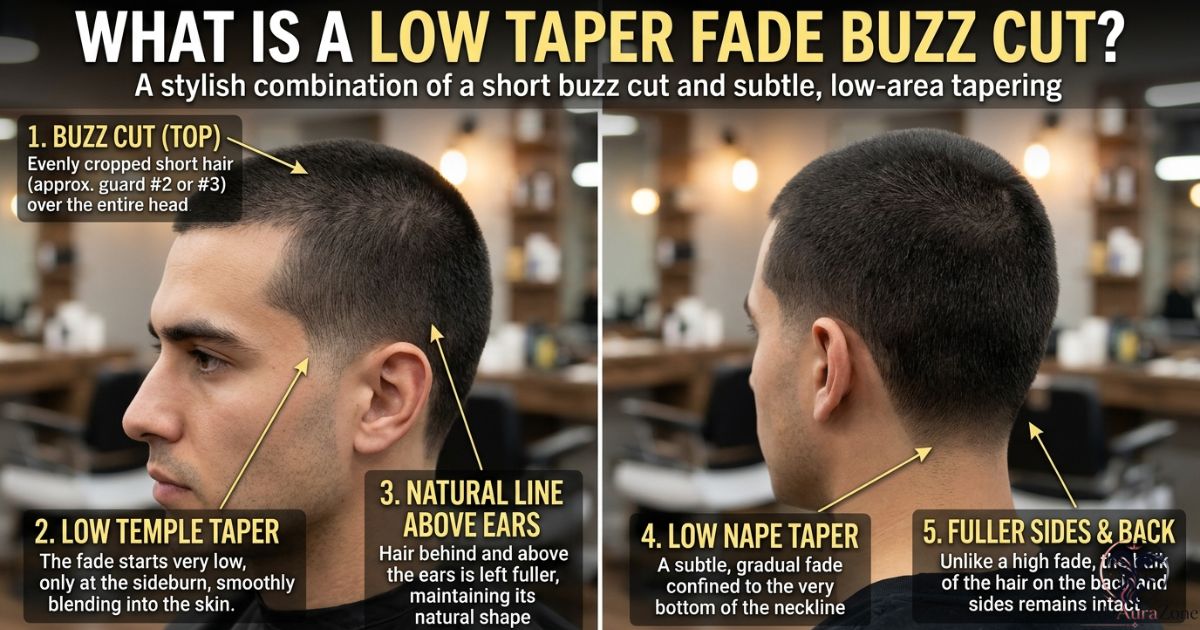
A low taper fade buzz cut pairs one short, even clipper length on top with sides that shorten gradually from just above the ear down to the neckline. The taper leaves a trace of hair at its shortest point, so the finish stays soft instead of bare.
Think of it as two separate decisions. The buzz sets how much hair sits on top. The taper sets how the sides and back shrink toward your skin. Because the fade starts low, nearly all the action happens around the ears and the nape. From across a room, the cut reads as one tidy, even length.
Why the starting point matters
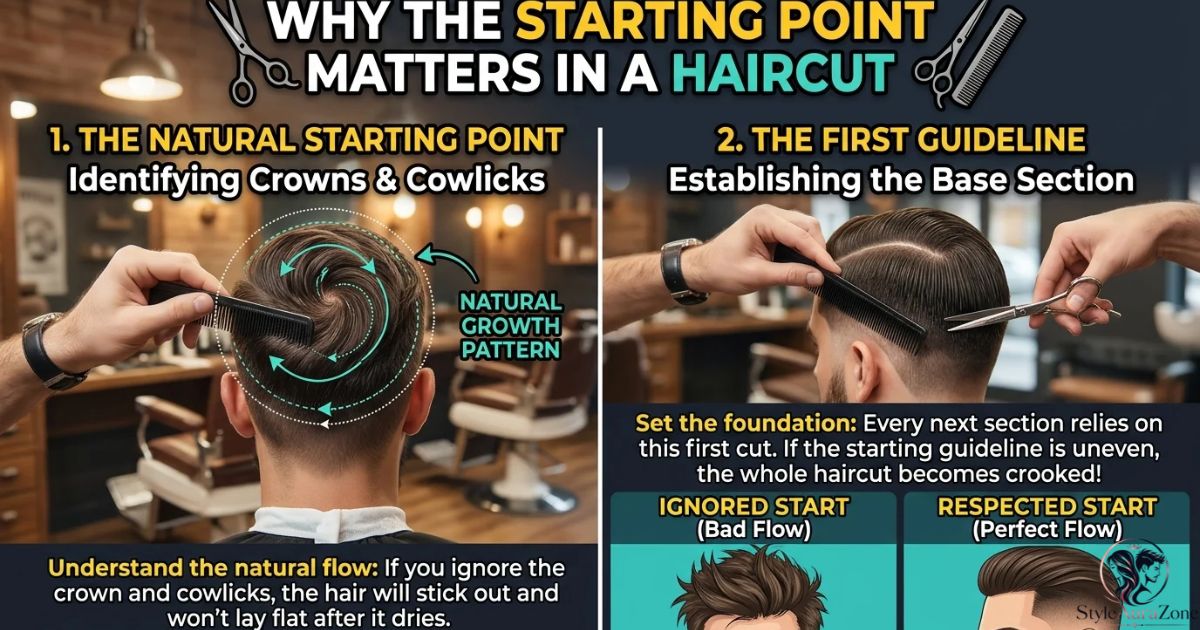
Fade height changes the mood of the whole cut. A high fade starts near the temples and creates strong contrast. A mid fade begins around the top of the ear. A low taper waits until the last stretch above the ear, so the sides stay full and the look stays calm.
That restraint explains why it fits boardrooms, classrooms, and gym floors equally well. It also protects your head shape. Buzzed hair offers no cover, and a fade that starts too high can make the crown look narrow or the sides look boxy. A low start gives you a safer margin.
What a taper adds that a plain fade doesn’t
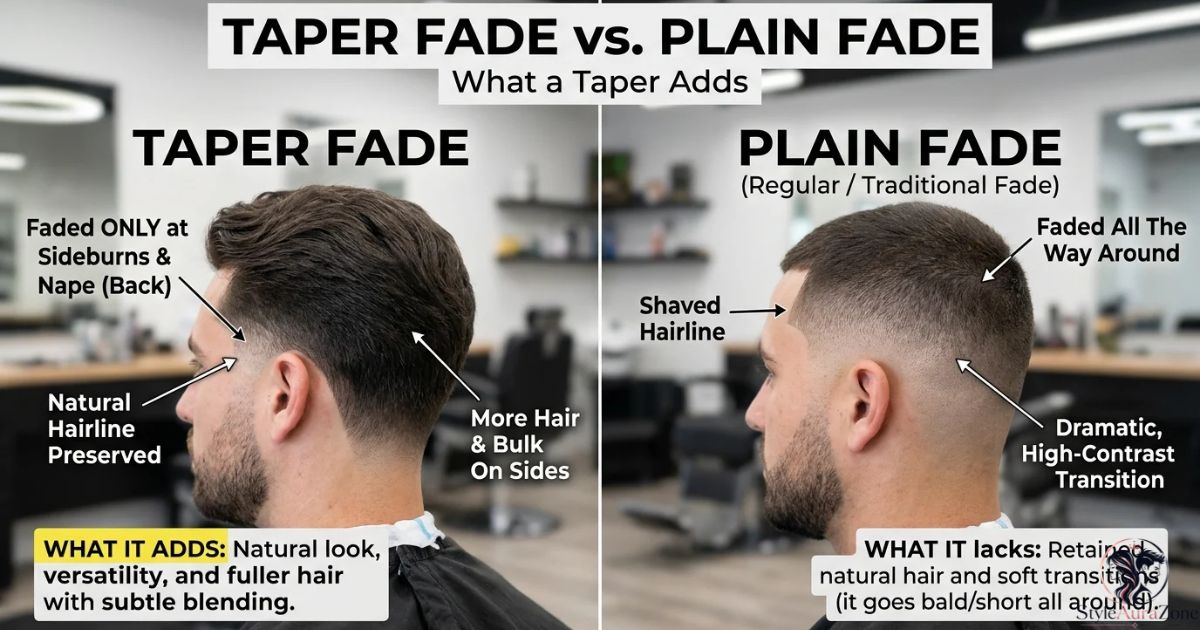
A plain fade often ends at bare skin. A taper stops short of that and keeps a whisper of hair, usually a #0.5 or #1 at the very bottom. The finish looks softer and hides uneven density.
Fine or thinning hair benefits most. A skin-close finish can expose patchy spots near the temples, while a taper blurs them. It also grows out with grace. You won’t see a harsh band of stubble creeping up your neckline after a week.
Read more:25 Best Modern Mullet Taper Styles for Men (2026)
Best low taper fade buzz cut styles
“Low taper fade buzz cut” covers a family of haircuts, not one fixed look. These are the versions barbers cut most often.
| Style | Top guard | Edge finish | Best for |
| Classic even buzz | #2–#3 | Natural, soft | First-timers and office settings |
| Edge-up buzz | #2–#3 | Crisp, razor-cut | Anyone who wants a polished frame |
| Longer tousled buzz | #5–#6 | Soft | Guys who like a little movement |
| Bearded taper buzz | #2–#4 | Beard blended into sideburns | Full facial grooming |
| Bleached-top buzz | #2–#3 | Natural | A bold look with minimal length |
| Part-line buzz | #2–#3 | Razor-cut part | A subtle design touch |
- Classic even buzz: One guard everywhere on top. It needs zero styling and suits nearly every schedule.
- Edge-up buzz: A barber squares the temples and sharpens the front hairline. This version looks freshest on day one.
- Longer tousled buzz: Extra length lets you rake in a pinch of matte paste. You get texture without losing the clean sides.
- Bearded taper buzz: The sideburn fade melts into the beard along the jaw. Hair and beard then read as one plan.
- Bleached-top buzz: Lightened hair sits closer to the color of skin. That softens contrast and makes the taper feel gentler.
- Part-line buzz: A thin razor line sits on one side of the top. It adds personality while the low taper keeps things grounded.
Choosing your buzz length: a clipper guard guide
Guard numbers add roughly 1/8 inch (3 mm) per step. Brands vary slightly, so ask your barber which guard set they use. The jump between sizes looks bigger on your head than on paper.
| Guard | Length | What you get |
| #1 | 1/8 in (3 mm) | Ultra close, scalp shows through |
| #2 | 1/4 in (6 mm) | Sharp, military-clean |
| #3 | 3/8 in (10 mm) | Soft texture, forgiving for most heads |
| #4 | 1/2 in (13 mm) | Visible texture, easy to dress up |
| #5 | 5/8 in (16 mm) | Enough length for a light product |
| #6 | 3/4 in (19 mm) | Short crop territory |
Most barbers blend the sides from a #0.5 or #1 at the neckline up into your top guard. A longer top guard therefore makes the transition look more gradual. A #2 on top makes the taper look tighter and more dramatic.
Hair density should drive the decision. Thick hair stays full at a #2. Thinner hair looks denser at a #3 or #4 because shorter guards reveal scalp. One barber guide from
also points to #2–#4 as the safe range for most clients, with a natural line-up.
Two quick rules protect you from regret:
- Start longer than you think you need. You can always go shorter next visit.
- Cut on dry hair. Wet hair clumps and makes any guard look shorter than it will once it dries.
Low taper fade buzz cut for straight, wavy, curly, and coily hair
Hair texture changes how a guard number looks. The same #3 can feel crisp on one head and fluffy on another.
| Hair type | Suggested top guard | What to watch |
| Straight | #2–#3 | Scalp shows sooner on fine hair, so consider a #3 |
| Wavy | #2–#4 | Crown swirls and cowlicks need extra blending |
| Curly | #3–#4 | Shrinkage makes hair look shorter once dry |
| Coily | #3–#4 | Keep the taper soft and watch for ingrown hairs |
Straight hair lies flat and grows in one direction. Clippers glide evenly, and the blend between top and sides looks crisp. Fine straight hair can look sparse at a #1 or #2, so go a notch longer.
Wavy hair carries natural volume. Even a short buzz shows a subtle ripple. Ask your barber to check the crown, because swirls there can leave a lumpy blend.
Curly hair springs up after cutting and drying. A #4 can settle closer to a #2. Many barbers use clipper over comb to keep the pattern intact and avoid scalping.
Coily hair looks best with a soft taper rather than a hard skin line. A bare edge can look disconnected against a dense coil. Moisturize the scalp often. Dry skin and close razor work raise the risk of ingrown hairs.
Best low taper fade buzz cut for your face shape
A buzz leaves nothing to hide behind. Face shape and head shape become the main event, so small adjustments matter.
| Face shape | Top guard | Edge style | Why it works |
| Oval | Any #2–#4 | Natural | Balanced proportions suit almost everything |
| Round | #4 or longer | Squared edge-up | Adds lift and sharpens the outline |
| Square | #2–#3 | Crisp edge-up | Echoes the strong jaw |
| Oblong | #3–#4 | Natural | Extra length avoids elongating the face |
| Diamond | #3–#4 | Soft edge | Balances wide cheekbones |
| Heart | #3–#4 | Soft edge | Keeps width from piling up near the forehead |
If you aren’t sure of your shape, take a straight-on photo in good light. Compare the width of your forehead, cheekbones, and jaw. Then let your barber confirm it. Barbers see hundreds of head shapes and can often spot a flat back or a high crown that changes the plan.
Line-ups and shape-ups: getting the edges right
Once the blend is done, the edges finish the look. A line-up (also called an edge-up) sharpens the front hairline and squares the temples. A shape-up cleans the whole outline, including the sideburns and the nape. Most barbers do both with a trimmer or straight razor.
| Edge style | Look | Lasts | Best for |
| Natural cleanup | Soft, barely noticeable | Up to two weeks | Office jobs and receding hairlines |
| Rounded edge-up | Gentle curve at the temples | About one week | Round and oval faces |
| Squared edge-up | Hard corners, high contrast | About one week | Square faces and event days |
A low taper is subtle, so a clean edge often decides whether the cut looks fresh or flat. Hairlines also regrow faster than the taper does. A sharp line-up starts softening within seven to ten days.
Don’t push the hairline back to chase sharpness. Repeated aggressive razor work can erode the edge over time, especially at the temples. Ask for a natural shape that follows your real hairline.
How to ask your barber for a low taper fade buzz cut
Most bad fades come from vague words. “Low fade” means slightly different things in different shops. A solid request covers three parts, which matches the framework in: the top, the sides, and the finish.
- Name the top. Say “a #3 on top” instead of “not too short.”
- Describe the sides. Say “low taper, starting just above the ear.”
- Set the bottom. Say “leave short hair at the neckline” if you don’t want skin.
- Choose the edges. Say “natural line-up” or “crisp edge-up.”
- Mention skin concerns. Flag razor bumps or sensitivity before the razor comes out.
“I’d like a #3 on top and a low taper on the sides. Start it just above the ear, and keep a bit of length at the bottom. Give me a natural line-up, nothing too sharp.”
Bring photos from the front, side, and back. Then check the finished cut with a hand mirror near a window. Natural light reveals uneven blends fast, and fixes are easier before you leave.
Low taper fade vs mid taper vs skin fade
Two choices get tangled here. Low, mid, and high describe where the fade starts. Taper and skin describe how short it gets at the bottom.
| Feature | Low taper fade | Mid taper fade | Skin fade |
| Start point | Just above the ear | Around the top of the ear | Low, mid, or high |
| Bottom finish | Short hair remains | Short hair remains | Bare skin |
| Contrast | Subtle | Moderate | Strong |
| Typical touch-up | Every 2–3 weeks | Every 2 weeks | Every 7–10 days |
| Best for | Work and low upkeep | A balanced, defined look | A sharp, high-definition finish |
The low taper wins on forgiveness. It never touches skin, so it blends into regrowth for longer. A skin fade looks crisp for a few days and then shows a stubble line. If you cut weekly and love razor-sharp contrast, a skin fade fits. If you’d rather skip the barber chair for three weeks, pick the low taper.
How to maintain a low taper fade buzz cut
Low maintenance doesn’t mean no maintenance. The ears and neckline lose their shape first, so a short routine keeps the cut looking deliberate.
| Task | How often |
| Professional touch-up | Every 2–3 weeks |
| Edge cleanup with a trimmer | Weekly |
| Top buzz with a guarded clipper | Weekly, if you like it uniform |
| Scalp moisturizer or light oil | Daily or every other day |
| Gentle exfoliation near razored edges | 1–2 times per week |
| Sunscreen on exposed scalp | Every sunny day |
A few habits make a real difference:
- Buzz dry hair against the grain. Work in small sections and check the back with a second mirror.
- Leave the taper to your barber. Blending between guards without a visible line takes practice. A slip near the ear shows more than an uneven top.
- Keep products light. A pinch of matte clay adds texture on longer buzzes. Heavy gels look greasy on short hair.
- Protect your scalp. Short hair offers little shade, so wear broad-spectrum SPF 30 or higher and a hat on long days outdoors.
- Invest in decent clippers. Dull blades pull hair instead of cutting it.
FAQ’S
What is a low taper fade buzz cut?
It’s a short, even buzzed top with sides that taper gently from just above the ear. The bottom keeps a little hair instead of showing bare skin.
Which guard works best on top?
A #3 suits most people. Choose a #4 for thinner hair and a #2 for thick hair.
How often does it need a touch-up?
Every two to three weeks keeps the taper crisp. The edges may need a quick cleanup around day ten.
Does a low taper work on curly or coily hair?
Yes. Ask for a slightly longer top to allow for shrinkage, and keep the taper soft.
Is it appropriate for an office job?
Yes. The subtle blend reads clean and professional.
Conclusion
The low taper fade buzz cut earns its popularity. It looks sharp, grows out gracefully, and asks for very little from you. Pick a guard that fits your hair density, match the edges to your face, and the cut does the rest. Small choices, like fade height and finish, matter more than any trend.
Walk into your next appointment with a guard number, a fade starting point, and an edge preference. Those three details beat any photo. Book a refresh every two to three weeks, protect your scalp from the sun, and enjoy a cut that works as hard as you do.