
Want a fresh cut that turns heads the second you walk out? A high taper fade black male style does exactly that. The fade starts high, right above the temple. It leaves length on top and cuts the sides down close to skin. This look works great for coils, curls, waves, and locs. A high taper fade black male cut gives sharp contrast, plain and simple. The top stays full. The sides stay tight and clean. Barbers love this style because it fits almost any face shape.
Here’s the real question: skin or guard? Picking a high taper fade black male style means picking the right guard number too. Skin fades look crisp but need touch-ups fast. A guard fade holds shape longer. Either way, a high taper fade black male cut brings bold style and easy upkeep. It works with beards, line-ups, and braids. Ready to find your perfect match? This guide breaks it all down, style by style.
What Is A High Taper Fade For Black Men

A high taper fade black male style starts its fade right above the temple bone. It leaves the top full and blends the sides down to skin or a low guard. This gives you sharp contrast without going overboard.
Guys with coils, curls, waves, or locs all wear this cut well. The fade height stays fixed, but the top style flexes to match your texture. That’s what makes it so versatile.
Barbers love this cut for one reason: it works on nearly every face shape. Square, oval, round, it doesn’t matter much. The high starting point does the heavy lifting.
WHAT IS A HIGH TAPER FADE?
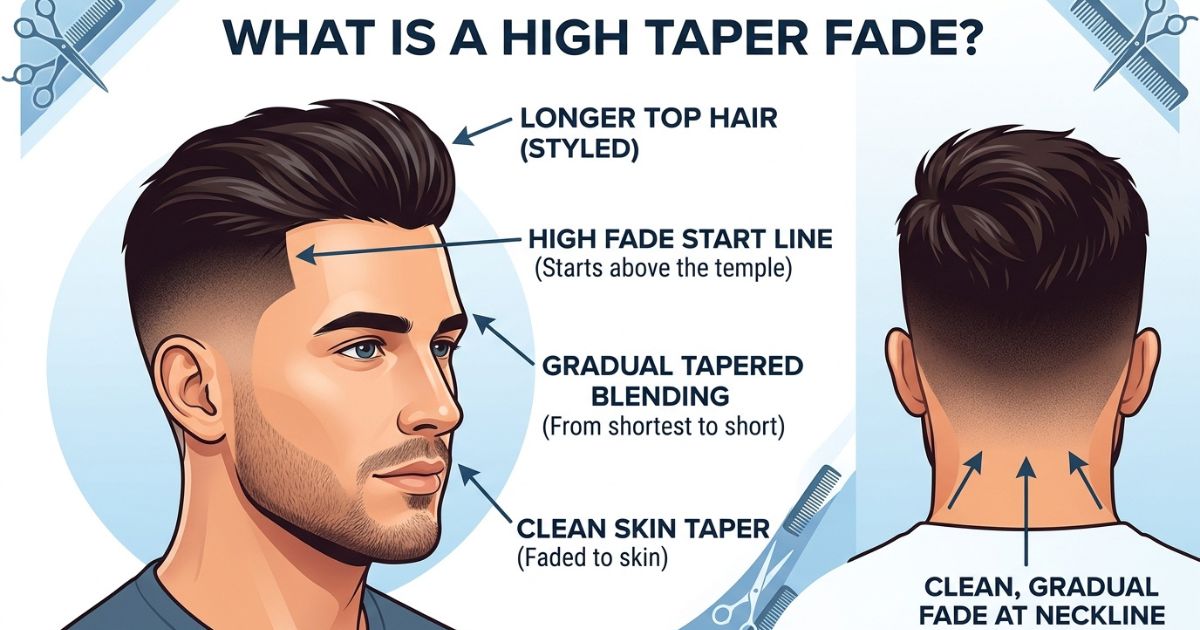
A high taper fade begins its gradient at or above the temple bone. From there, it blends down toward the ear and neckline until it hits skin or a very short guard. That gradual blend is what separates a taper from a plain buzz cut.
The word “high” points to where the fade starts, not some vague style label. Barbers use the temple as their landmark. Start above it, and you’re in high territory. Start right at it, that’s mid. Closer to the ear, that’s low.
A taper and a fade are actually two different techniques. A taper shortens hair gradually and never touches bare scalp. A fade goes all the way down to skin. Combine both from a high starting point, and you get maximum length on top with maximum contrast on the sides.
HIGH TAPER FADE VS. HIGH FADE VS. TEMP FADE
These three cuts get mixed up constantly, but they’re not the same thing. A high taper fade blends gradually from length on top down to skin. A high fade skips the gradual part and jumps to skin almost right away, which makes for a sharper, more abrupt line.
A temp fade is a different animal entirely, even though barbers sometimes use the names loosely. It only fades the temples and sideburns, leaving the back and crown alone. A high taper fade touches the whole side and back of the head.
Naming gets messy shop to shop, and that’s not really anyone’s fault. Barbering never standardized its terms nationally. Your best move? Skip the label and describe the anatomical starting point instead. Say “start it above my temple,” and you’ll get what you actually want.
WHICH STYLE FITS YOUR HAIR TEXTURE?
Your hair texture decides which high taper fade variation will actually match the photo you bring in. Loose curls behave nothing like tightly coiled hair under the clippers. A wave pattern needs training time an afro simply doesn’t require.
| Hair Type | Texture | Recommended Top Styles | Note |
| Type 3A–3B | Loose to medium spirals | Textured crop, curly top, slick back | Works at 3+ inches |
| Type 3C | Tight spirals | Curly afro, sponge curl top | Allow extra length for shrinkage |
| Type 4A | Defined coils | Afro, sponge curls, twist-out top | Moisture protocol needed after cutting |
| Type 4B | Z-pattern coils | Afro, coil top, braided top | Plan for significant shrinkage |
| Type 4C | Tightly packed coils | Box afro, loc base | Longest grow-out for top styles |
| 360 Waves | Trained pattern | Waves on top, high skin taper | Durag needed after every cut |
| Locs | Formed or growing | Loc top, faded sides | Plan ahead before cutting |
| Braids | Cornrows on top | Braided high taper | Plan ahead before cutting |
Once you know your texture, picking the right top style gets a lot easier. You’re not guessing anymore. You’re matching a proven combination to your own head.
HIGH TAPER FADE WITH AFRO OR NATURAL TOP
A box afro paired with a high taper fade builds a flat, structured silhouette. The shaved temples contrast hard against the fuller crown, and that contrast turns loose coils into something deliberate.
This combo shines on Type 4A and Type 4B coils especially. The density up top holds its shape right against that sharp fade line, so nothing looks flat or undefined.
Want to finish it off right? Add a beard blend. It connects the faded sides straight into your jawline instead of leaving an awkward gap between hair and beard.
HIGH TAPER FADE WITH 360 WAVES
Waves need a trained pattern before any cut can show them off. A high taper fade gives that pattern serious contrast against bare skin, and the higher it starts, the more your waves seem to spin toward the crown.
Right after your cut, that exposed skin along the fade line needs care. It’s freshly bare and prone to drying out fast.
Grab a durag or wave cap for a few hours post-cut. It sets your pattern in place and protects the skin from moisture loss while it heals.
HIGH TAPER FADE WITH COILS (TYPE 4A–4C)
Tightly packed coils create serious contrast against a skin-level high taper fade. The density on top separates visually from the bare sides almost instantly, which is exactly why barbershops see so many requests for this combo.
Aftercare matters more here than with looser textures. Your scalp just got exposed, and your coil pattern probably got disturbed during the cut.
Try this: moisturize the faded sides within a day, use a curl cream on top to bring the coils back, then sleep in a satin bonnet to lock everything in overnight.
HIGH TAPER FADE WITH LOCS OR TWISTS
Locs and twists sit beautifully on top of a high taper fade, but the sides need careful handling first. Your barber will gather and clip back anything grippable before touching the clippers.
Once that’s done, the fade only hits the remaining length at your temples and nape. The locs or twists up top stay completely untouched.
This combo looks sharp the moment you leave the chair. There’s a trade-off worth knowing about though, especially if you’re planning to grow more locs later on.
HIGH TAPER FADE WITH TEXTURED CROP OR SHORT TOP
A textured crop keeps things short and low-maintenance while still contrasting hard against a high taper fade. Plenty of guys go straight for this pairing because it just works with minimal daily effort.
You’ll want around 1.5 to 2 inches on top for the crop to hold real texture and fringe definition. Go shorter than that, and it starts looking more like a plain buzz.
Either way, your barber can still nail the high taper fade on the sides. The top length is really the only variable changing here.
30 HIGH TAPER FADE STYLES FOR BLACK MEN

Every high taper fade black male style below comes with a guard number, a base finish, a face-shape fit, and a line you can hand straight to your barber. Think of these as starting points, not rigid rules.
Your barber may nudge the numbers based on your natural density and how fast your hair grows. That’s normal, and it’s actually a good sign they’re paying attention to your head specifically.
From box afros to loc tops to beard blends, this list covers nearly every texture and every finish. Scan for your category, grab the script, and take it to your next appointment.
Afro & Natural Top: Box Afro High Taper, Rounded Afro High Taper, Tapered Afro Puff, Curly Afro Fade, Textured Natural Top, High-Volume Afro Taper
Coil & Sponge Curl Top: Sponge Curl High Taper, Defined Coil Crop, Twist-Out High Taper, Coily Crown Fade, Loose Coil Taper
360 Waves Top: High Skin Taper with Waves, 540 Wave High Taper, Wave Pattern Crop, Textured Wave Taper
Textured Crop & Short Top: Classic Textured Crop, French Crop High Taper, Buzz Cut High Taper, Caesar Cut High Taper, Short Curly Crop
Locs Top: Loc High Taper, Faded Sides with Loc Bun, Starter Loc Fade
Braids & Twists Top: Braided Top High Taper, Two-Strand Twist Taper, Flat Twist High Taper
Beard Blend Pairings: High Taper with Full Beard Blend, High Taper with Line-Up and Beard, High Taper with Goatee Blend
Design & Line-Up Variations: High Taper with Shaved Design
DOES YOUR HAIR LENGTH SUPPORT THIS CUT?
Most high taper fade styles need a minimum top length before they’ll actually hold their shape. A textured crop works at just over an inch. A full afro or twist-out needs several inches, and that’s before you even factor in shrinkage.
| Top Style | Minimum Length | Notes |
| Textured Crop | 1–1.5 inches | Cuttable right away |
| Sponge Curl Top | 1.5–2 inches | Needs room to form the coil |
| Afro Top | 2–3 inches after shrinkage | Type 4C may need extra |
| 360 Waves | 1–1.5 inches | Pattern must already be trained |
| Braided Top | 2.5–3 inches | Needs length to grip and braid |
| Loc Top | Locs already formed | Side locs may need sacrificing |
If your current length can’t support the style you’re after yet, don’t force it. A lower-contrast option, like a mid or low taper, can deliver a clean look with less length required.
WHAT SHOULD YOU TELL YOUR BARBER?
Getting an accurate cut comes down to one thing: specifics. Name the exact starting point, the base finish, and your top length in one sentence, rather than leaning on a style name that means different things in different shops.
Here’s a script you can copy and fill in: “I want a high taper fade. Start it above the temple bone. Fade the sides to [skin or a guard number] at the base. Leave [length] on top. Shape the neckline [squared/rounded/tapered].”
Bring a side-angle reference photo too, not just a front-facing one. A front view hides exactly how high the fade starts and how much taper actually shows on the sides.
Learn more:Low Taper Fade for Kids: 25+ Boys’ Styles by Age (2026)
HOW OFTEN DOES IT NEED A TOUCH-UP?
A skin-based high taper fade looks sharpest for about five to seven days before growth starts showing. Bump that up to a #1 guard at the base, and you’ll stretch that window to ten or fourteen days instead.
| Fade Base | Sharp For | Full Reset Needed |
| Skin / 0 Guard | 5–7 days | 2–3 weeks |
| #0.5 Guard | 7–10 days | 2–3 weeks |
| #1 Guard | 10–14 days | 3–4 weeks |
| #2 Guard | ~2 weeks | 4–5 weeks |
The lower your guard number at the base, the sooner you’ll need to book another appointment. Plan your maintenance rhythm around that trade-off, not just around how the cut looks on day one.
WILL IT WORK WITH FUTURE LOCS OR BRAIDS?
A high taper fade strips away a good chunk of side hair, and that matters if locs, braids, or twists are somewhere in your future plans. The finish you pick today shapes how much growth you’ll have to work with later.
Skin fades remove side hair almost completely. A #1 or #2 guard instead keeps more of it intact while still giving you that high-contrast look everyone notices.
Some barbers call this a “soft high taper,” high starting point, guard finish instead of skin. It’s built for guys who bounce between a tapered look and a protective style down the line.
IF YOU WANT LOCS LATER
Going skin at the base means starting your locs from scratch once you’re ready. That hair has to regrow completely before you can even begin the loc process.
A #1 or #2 guard changes that math. You’ll keep more side hair in reserve, which shortens your wait time considerably.
Tell your barber this preference before they pick up the clippers. It’s a five-second conversation that saves you months down the road.
IF YOU WANT BRAIDS OR CORNROWS LATER
Braids need real length to grip properly, usually a couple of inches at minimum. A skin fade leaves you nowhere close to that.
Choosing a higher guard base instead keeps your side hair closer to braidable length from the start. You won’t be starting from zero.
It cuts down your wait considerably. Instead of months, you might only need a few extra weeks before your next protective style.
IF YOU WANT TWISTS LATER
Twists carry similar length demands to braids, so the same logic applies here too. Going skin means a longer wait before you can twist anything at all.
A #1 or #2 guard base keeps more usable length on the sides in the meantime. That’s length you can actually work with sooner.
It’s a small trade for a lot of future flexibility. Mention it to your barber, and they’ll adjust accordingly.
HOW DO YOU MAINTAIN IT AT HOME?
Between barbershop visits, a handful of home habits keep your high taper fade looking sharp. This matters even more on textures that dry out fast after clipper work.
A trimmer works fine for cleaning up your neckline and line-up between cuts. Keep it away from the actual fade gradient though, since one uneven pass can leave a visible line that’s tough to fix.
Moisture is your best friend here. Freshly faded skin dries out quickly, so a light routine between appointments keeps both your scalp and your cut looking their best.
HOME MAINTENANCE FOR WAVES
Freshly faded skin along a wave taper needs moisture right away since the hair’s been cut close to the follicle. Grab a light, water-based moisturizer and apply it to the exposed sides.
After that, wear a durag for a few hours post-cut. It helps set your wave pattern while it protects the newly bare skin from drying out.
Skip this step, and your waves won’t pop the way they should. It’s a small habit that makes a real difference.
HOME TOUCH-UPS: WHEN AND HOW
A trimmer handles neckline cleanup and line-up touch-ups just fine between barbershop visits. It’s quick, it’s easy, and most guys can do it themselves without much practice.
Don’t touch the actual fade gradient with it though. That blended zone on the sides takes real skill, and a home trimmer pass can create an uneven line fast.
If it’s not your neckline or your line-up, leave it to the professionals. One bad pass can force a shorter fix than you wanted.
FREQUENTLY ASKED QUESTIONS
What’s the difference between a high taper fade and a high fade? A high taper fade starts above the temple and blends gradually to skin. A high fade also starts high but jumps to skin almost immediately, creating a sharper line.
What guard numbers work for a high taper fade? Most barbers use a #3 or #4 on top, a #2 at the midsection, a #1 near the base, and skin at the lowest point, adjusted to your density.
Does a high taper fade work for Type 4C hair? Yes. Tight coils create serious contrast against a skin or low-guard taper. Keep the sides moisturized and use curl cream on top to finish the look.
How long will it stay sharp? A skin-base cut stays sharp for five to seven days. A #1 guard base stretches that to ten or fourteen. Most barbers suggest a touch-up every two to three weeks.
Can I get one if I want locs later? Yes, just pick your base wisely. A #1 or #2 guard preserves growth for future locs, while skin means starting from scratch.
What should I say in the chair? Try this: “I want a high taper fade. Start it above my temple bone. Fade the sides to [skin or a guard] at the base. Leave [length] on top.”
KEY TAKEAWAYS
A high taper fade black male style delivers bold contrast and real flexibility, whether you’re rocking coils, curls, waves, locs, or braids. Match the right guard number and top length to your texture, and this cut works for nearly any face shape you’ve got.
The difference between a great result and a disappointing one usually comes down to communication. Name your exact starting point, pick a base finish that fits your future plans, and bring a side-angle photo instead of relying on the style name alone.
Whether you’re chasing sharp skin contrast or building toward future locs, a high taper fade black male cut adapts to where you’re headed. Talk to your barber, know your texture, and walk out with a cut that actually fits your head.
How to Ask for a Mid Taper Design: Barber-Approved Terminology & Back-View Gallery
Not ready to commit to the drama of a high taper? A mid taper design offers a softer starting point with plenty of style options. Check out the barber-approved terms and back-view gallery to see how it compares.
High Taper Fade for Curly Hair: 20 Styles, Face-Shape Guide, and Barber Tips
Curly hair brings its own set of rules to a high taper fade. This companion guide breaks down 20 curl-specific styles, matched to face shape, with the same barber-ready scripts you’ve seen here.
Blowout Taper Textured Fringe – Low, Mid & High: What to Ask For and How to Style It
Want more volume up front? A blowout taper pairs a textured fringe with your choice of low, mid, or high sides. This guide covers exactly what to ask for and how to style it after you leave the chair.
High Blowout Taper Haircut Guide: Low vs Mid vs High, Every Hair Type
Every hair type handles a blowout taper differently. This guide walks through low, mid, and high options side by side, so you can pick the height that actually suits your texture and face shape.
Mid Blowout Taper: Definition, Variations & the Exact Barber Script to Get It Right
The mid blowout taper sits right between subtle and bold. This breakdown covers its key variations plus the exact script to hand your barber, so you walk out with precisely what you asked for.
Low Taper Blowout: What It Is, Who It Suits, and How to Ask Your Barber
Looking for something more understated? The low taper blowout keeps things natural while still adding volume up front. Here’s who it suits best and exactly how to ask your barber for it.
FAQ’S
What is a high taper fade black male style?
It’s a fade starting above the temple bone, blending down to skin on the sides, while keeping length and texture full on top.
What guard number works best for a high taper fade black male cut?
Most barbers start with a #3 or #4 on top, tapering down through a #2, a #1, then skin at the base.
How long does a high taper fade black male cut stay sharp?
A skin-based fade holds its edge for five to seven days. A guard finish stretches that window out to ten or fourteen days.
Does a high taper fade black male style work with coils?
Yes, it works great. Coils create strong contrast against the fade, and moisturizing the sides keeps everything looking clean and healthy.
Can I still loc my hair after a high taper fade black male cut?
Absolutely, just choose a guard base instead of skin. That keeps enough side length ready for locs down the road.
Conclusion
The guide “High Taper Fade for Black Men: 30 Styles + Barber Script” breaks down every option you need. A high taper fade black male style works with coils, curls, waves, and locs. It gives sharp contrast on the sides and keeps your top full. Pick the right guard number for your texture. Talk to your barber using clear terms, not guesses.
A high taper fade black male cut fits almost any face shape. It pairs well with beards, line-ups, and future protective harstyles. Bring a side-angle photo to your next visit. Know your texture, know your script, and walk out with a high taper fade black male look that actually works for you.